“Dead man walking,” a correctional officer shouted outside of San Quentin’s Receiving and Release, with his hand firmly gripping my arm while my hands were cuffed behind my back and legs shackled. I was twenty-two years old when I was sentenced to death for the horrendous murder-robbery-turn-shooting-spree that I had committed when I was nineteen. At the time, I was filled with anger and hate at the world, God, but most of all, at myself.
This darkness inside of me was met with the despondency that filled California’s death row as the state was gearing up for the execution of Robert Lee Massie. Reality did not hit me until I felt the stillness blanket death row right before he was executed. That’s when I understood, I am here to die. I felt this jarring silence twice more with the executions of Clarence Ray Allen and Stanley “Tookie” Williams.
Hope was nonexistent on death row as I watched people that I’ve known for decades commit suicide, die from overdoses, killed by the hands of another condemned inmate, or simply perish from a lack of medical care. I never thought that I would make it out of San Quentin alive. This prison was my tomb and I was dying a slow death.
That changed during the pandemic when a judge ordered San Quentin to empty out half of its population due to the COVID-19-related deaths of twenty-eight inmates (most on death row) and one correctional sergeant. I was one of the seventeen condemned prisoners that left San Quentin on an experimental pilot program to integrate death row inmates with the general prison population in November of 2020.
The smell and sight of the green grass filled me with life and promise as I walked onto the yard at Corcoran State Prison. Death row was devoid of color and the yards were concrete surrounded by a concrete wall painted a dull yellow. But in the shadow of Corcoran’s notorious past, I was reborn and embraced the light that was buried deep within my heart.
I enrolled in school, acquiring a GED and a vocation in Computer Related Technologies as well as immersing myself in self-help books and programs, proceeding to the root of my self-hatred to alleviate this toxic mindset. Reforged, I focused on giving back to society by mentoring at-risk youths from the local high schools in the Central Valley in the Rehabilitate, Educate, and Create Hope Program, which is not a Scared Straight, but rather, we take a big brother approach by sharing our stories to help change the direction of these kids’ lives.
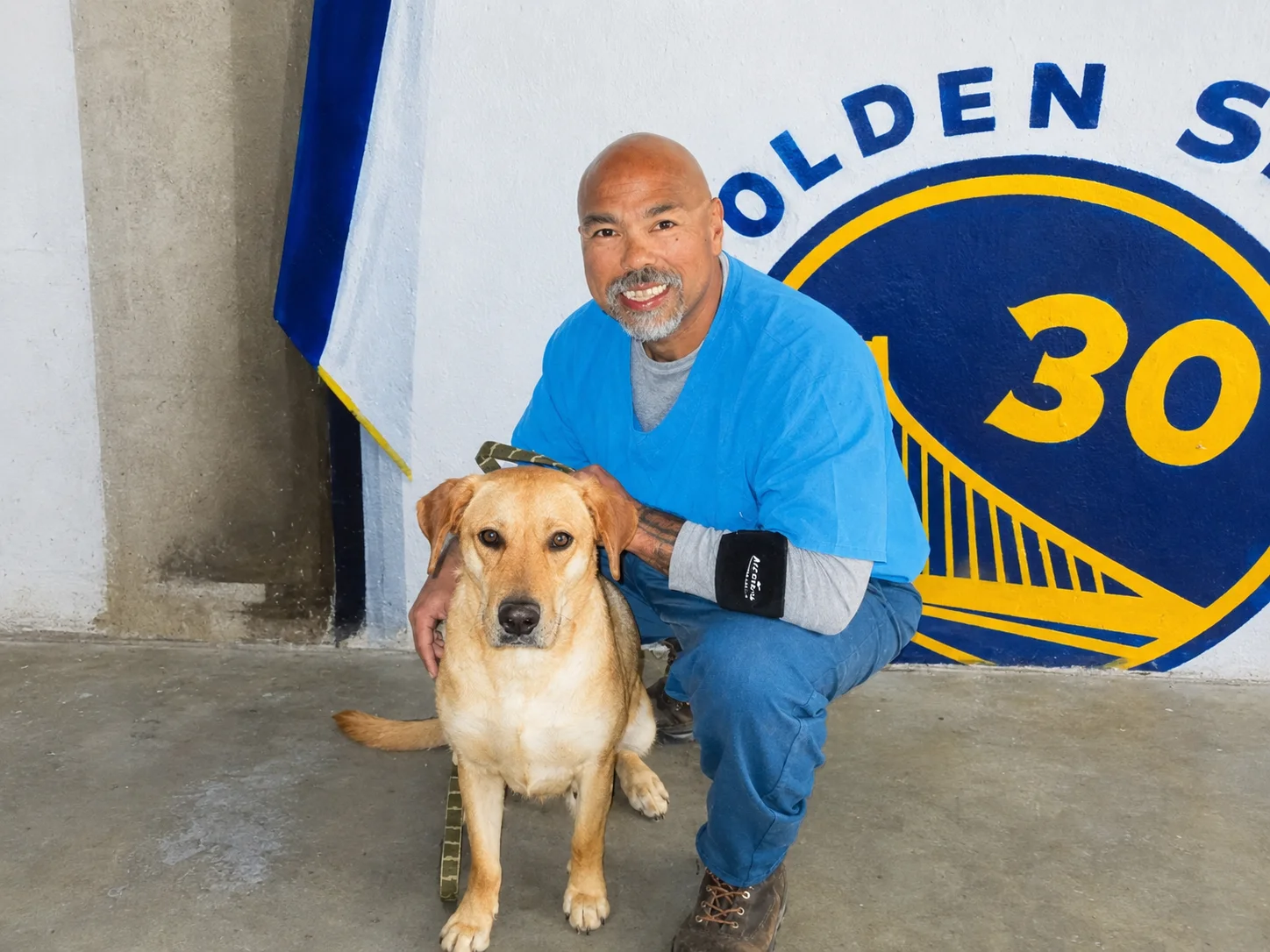
Looking to further expand my mind, I registered in college and attained six AA degrees. Although these programs contributed to rehabilitation, it was the Dog Program that taught responsibility. The welfare of both of my dogs, Ranger and Zelle, helped me understand that the world does not revolve around me and my needs. They were like my kids and I put their demands above my own. That’s when it clicked. We are bound together in society and therefore, prosocial behavior will allow all of us to grow as one.
That’s when I made the choice to apply for the Occupational Mentor Certification Program, which certifies incarcerated persons as addiction counselors, to help my community overcome their substance use disorder that most likely stems from their traumas. After all, it was drugs that ruined my family, community, and my own life. Thus, by facilitating Integrated Substance Use Disorder Treatment groups within the prison, I will uplift my brethren, so that they can go back into society healed, which would reduce recidivism and the making of more victims.
However, I find myself in a state of conflict for the person that I have become today. I just don’t understand why it had to cost so much for me to become successful? I understand the pain and the anguish that I had caused to my victims and their families. Previously, my self-hatred blinded me from my own humanity and therefore, could not see the humanity in others. But once I learned to love myself, the comprehension of what I had wrought struck me and I now mourn daily for my victims. In their memory, I have made a vow to never commit another act of violence ever again, even if I am attacked.
Dead man walking. Although I am no longer on death row, I am still a condemned man. Yet, I am no longer that destructive nineteen-year-old filled with misery that cannot help but to express and make decisions from this inner state. Instead, I have evolved by taking advantage of every educational, vocational, and rehabilitative program available as well as learning to love myself. Consequently, I now live to make amends by giving back to society by aiding the recovery of those behind these walls as an addiction counselor, offering hope, life, and a second chance to this population as a means of offering restitution to society as a whole.